Rectangular Tube Load Calculator — RHS & SHS Beam
Check RHS or SHS bending stress, deflection and estimated load capacity for steel, stainless steel or aluminum with simple, fixed or cantilever supports.
Rectangular tube beam check
Preliminary elastic check for RHS or SHS beams. Compare bending stress, deflection and a load estimate.
100 × 50 × 3.0 mm · 150.0 kg/m
Tube and loading
Beam response
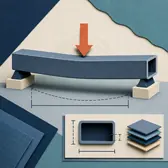
Ideal simple supports · uniform load. Diagram curvature is exaggerated.
Utilization
Section properties
Compare common tube sizes
The table rechecks every section against your current span, load, supports, material and serviceability limit. “Lightest pass” means the lightest option in this short comparison set, not a code-based final selection.
| Tube H × B × t | Weight | Deflection | Governing use | Result | |
|---|---|---|---|---|---|
| 40 × 40 × 2 mm | 2.39 kg/m | 107.42 mm | 859.3% | Does not pass | |
| 60 × 40 × 3 mm | 4.43 kg/m | 29.16 mm | 233.3% | Does not pass | |
| 80 × 40 × 3 mm | 5.37 kg/m | 14.39 mm | 115.1% | Does not pass | |
| 100 × 50 × 3 mm | 6.78 kg/m | 7.23 mm | 57.9% | Lightest pass | |
| 120 × 60 × 4 mm | 10.80 kg/m | 3.26 mm | 26.1% | Passes | |
| 100 × 100 × 4 mm | 12.06 kg/m | 3.55 mm | 28.4% | Passes | |
| 150 × 100 × 5 mm | 18.84 kg/m | 1.16 mm | 11.1% | Passes | |
| 200 × 100 × 6 mm | 27.13 kg/m | 0.51 mm | 6.5% | Passes |
What this calculator checks
It models a straight prismatic rectangular or square hollow metal tube in small elastic bending. Results include major-axis inertia, section modulus, bending stress, center deflection and a live-load estimate.
Support and load cases
Choose a full-span uniform load or a point load, with ideal simple supports, fixed ends or a cantilever. The point load acts at midspan for two-ended beams and at the free end for a cantilever. Real connection stiffness is often between ideal cases.
Why orientation matters
Depth is raised to the third power in the inertia equation. Turning a rectangular tube so its taller side is vertical can reduce deflection substantially without changing its weight.
How the section comparison works
Each row uses the same beam equations as the main result and includes the candidate tube’s own weight when that option is enabled. A section passes only when both bending and the selected L/n deflection limit pass. Apply a row to inspect all forces, properties and the exaggerated SVG deflection before deciding what to verify with your local standard.
Units and self-weight
Metric and US inputs are converted to a single N–mm calculation. Optional self-weight is derived from the ideal sharp-corner section area and the selected material density. Material presets set elastic modulus, density and a typical yield strength; verify the actual grade before use.
Continue from one beam to the whole structure
This page checks one idealized tube. Use the dedicated editors when the load is shared by a frame or truss rather than assuming that a single beam result represents the complete structure.
Need to combine several point loads or load only part of the span? Use the beam deflection calculator with shear and moment diagrams and your section's E and I.
Frequently asked questions
Does higher-yield steel reduce deflection?
No. Yield strength changes the stress limit, while elastic deflection primarily depends on load, span, modulus and section inertia.
Is this an AISC or Eurocode design check?
No. It is a transparent preliminary elastic screen, not a complete code check or a substitute for a structural engineer.
Why can deflection govern before strength?
Long spans amplify deflection by the third or fourth power of length, so a beam can remain below yield but still be too flexible for serviceability.