Pool Salt Calculator
Work out how much pool salt to weigh, how many bags to buy and what remains. Preview salt levels and compare high-salt readings.
How much salt to add
Use a recent salt test and your equipment’s target. Starting values are examples, not recommended salt levels.
Your pool
For your target of 3,200 ppm
20 lb owned + 80 lb purchased = 66.763 lb to weigh + 33.237 lb remaining.
Your salt supply
Measurement uncertainty
Your own plausible bounds; not confidence intervals or a dosing guarantee.
Ideal mixing comparison
Discuss options with a pool professional. This comparison does not authorize draining: groundwater, pool structure, liners and discharge rules may make replacement unsafe.
Explore the salt level
A preview changes the comparison, not the target or purchasing plan.
40 lb would bring the nominal reading to 2,879.306 ppm.
Explore a worked example
How to use the result
Use an approved salt product and follow your equipment and pool-surface instructions for adding, circulating and retesting. Confirm volume and reading before acting on a small correction. The calculated mass is not a recommendation to add it all at once. Salt concentration alone does not establish safe swimming water.
Evaporation removes water, not dissolved salt; do not automatically add salt when topping up evaporated water. Splash-out, backwashing and leaks are different.
Purity adjusts the product mass arithmetically; it does not approve additives. The Hayward Salt & Swim 3C manual specifies greater than 99% NaCl and excludes rock salt, iodized salt and anti-caking additives. Follow your own model’s requirements.
Formula, units and limits
For dilute pool water, ppm is approximated as mg/L. Product kg = liters × (target − current ppm) ÷ (1,000,000 × purity fraction). Bags to buy = round up(max(0, required mass − owned mass) ÷ bag mass). Exact input fractions determine purchase boundaries; display rounding never changes the number of bags.
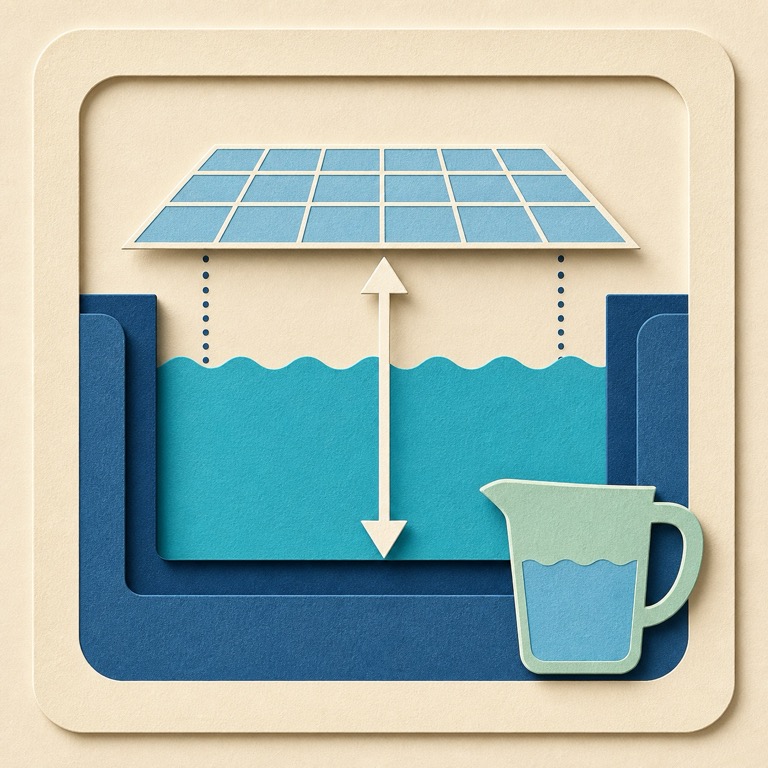
Preview ppm = current ppm + product kg × purity fraction × 1,000,000 ÷ liters. The diagram shows concentration, not water depth. Optional bounds combine supplied volume and reading extremes, treating target and purity as fixed; they are not statistical confidence levels.
Ideal replacement fraction = (current − target) ÷ (current − fill-water ppm). Compared final ppm = current × (1 − fraction) + fill-water ppm × fraction. This assumes one removal from an initially well-mixed pool, refill to its initial volume and complete mixing. It does not model continuous overflow, repeated exchanges or a safe work procedure.
1 US gallon = 3.785411784 L; 1 lb = 0.45359237 kg. Imperial gallons are not supported. Decimal dot or comma, up to 12 decimal places. Arithmetic limits: volume 0.001–1,000,000,000 L; current and fill 0–20,000 ppm; target 0.001–20,000 ppm; purity 99–100%; bag 0.000001–10,000,000 kg; stock and preview 0–1,000,000,000 kg; volume uncertainty 0–50%; reading uncertainty 0–20,000 ppm. These are software limits, not equipment recommendations. Mass displays round to 0.001 of the chosen unit; use a suitable scale.
Sources: Hayward Salt & Swim 3C manual; Pentair IntelliChlor Plus/LT FAQ; NIST unit conversions. Manufacturer targets differ; the example is not universal.